Emotional Regulation for Preschool to Second Grade
It is important to help our children identify emotions.
Early emotional development lays the foundation for later academic performance, mental health, and the capacity to form successful relationships. Despite this knowledge, most policies related to early childhood focus exclusively on cognitive development as it relates to school readiness, neglecting the importance of capacities such as the ability to regulate one’s own emotions and behaviour, and to manage successful interactions with other people (Center on the Developing Child, Harvard University).
By second grade, children should be able to identify 16 different emotions.
In preschool,we start with the basic 4 - Mad, Sad, Happy, and Scared. As children demonstrate an understanding of these emotions we add more. (see below)
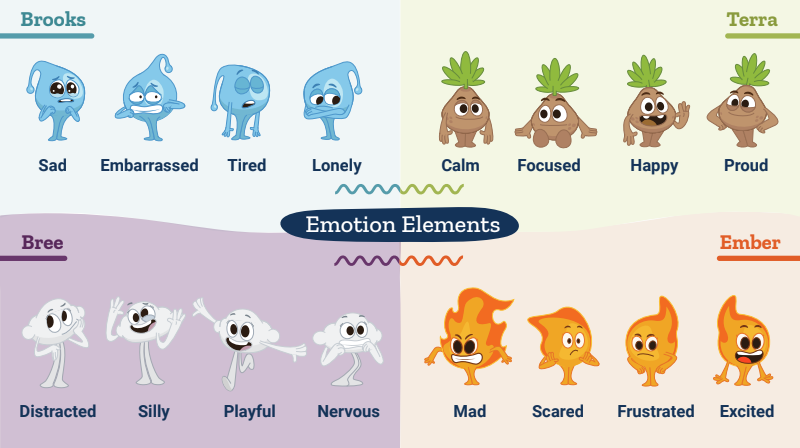
Children are very capable of handling big or not-so-good feelings. What creates lasting challenges is being left alone with those feelings. Second, the fact that it’s really hard to watch kids sit with hard feelings. Naturally, we want to protect them. Maybe we avoid telling them about something that will make them sad, or explain it in ways that we think will be easier to hear. Or, maybe it is hard to watch our child experience sadness/hurt and quickly look for some way to make them feel better.
Emotional Regulation is the interplay of temperament and personality AND environment
Emotion regulation is not just about expressing emotions in a socially appropriate manner. It is a three-phase process.
- Teaching children to identify emotions.
- helping them identify what triggers those emotions
- teaching them to manage those emotions by themselves.
When we teach kids that their emotions are valid, we help them view what they feel as normal and manageable.
We approach self-regulation skills in the same way we approach other skills, academic or social: isolate that skill and provide practice, When you think of it as a skill to be taught — rather than, say, just bad behavior — it changes the tone and content of the feedback you give kids.
The key to learning self-regulation skills, is not to avoid situations that are difficult for kids to handle, but to coach kids through them and provide a supportive framework — clinicians call it “scaffolding” the behavior you want to encourage — until they can handle these challenges on their own.
Co-Regulation
At its heart, co-regulation is connecting with a child who's in distress and being able to evaluate what that child needs in the moment to help calm themselves.
First, parent needs to pause and self-regulate their own emotions, such as by taking a deep breath. The next steps are validating the child's feelings, observing the child's response, and deciding how to respond next, including verbally and nonverbally, such as with a touch.
Teaching young children to recognize and regulate their emotions has many benefits.
Emotional self-regulation helps children ground themselves when they experience big emotions. It helps them feel good about themselves, decreases feelings of shame and anxiety tied to uncontrollable emotions, and it helps them cope and thrive within social settings and relationships.
Self Regulation Skills
- emotional awareness and literacy, including the ability to identify emotions
- self-soothing
- perspective-taking, or the ability to "walk in another's shoes"
- social skills such as taking turns and
- practicing patience
- paying attention and remaining focused when needed
- problem-solving
- thinking flexibly
- time management skills
- goal-setting
In conclusion, fostering emotional regulation in young children is just as critical as developing cognitive skills for school readiness. By teaching children to identify, understand, and manage their emotions, we equip them with the tools they need not only to succeed academically but also to thrive socially and emotionally throughout their lives. Emotional self-regulation enhances self-esteem, reduces anxiety, and enables children to navigate the complexities of social interactions with confidence and empathy. Importantly, this process requires a supportive, responsive environment where adults model and scaffold emotional skills. Rather than shielding children from difficult emotions, we must guide them through these challenges, helping them view emotions as normal, manageable experiences. When we prioritize emotional development alongside cognitive growth, we help children build a strong foundation for lifelong mental well-being and successful relationships.